It’s as simple as receiving a call from an unfamiliar phone number.
The message worries you: “This is the Police Department. Your car was recorded crossing a red light. Pay your fine now in order to avoid arrest. Call this number for further details.”
The voice on the other end warns you to not hang up. You are directed to go to a cryptocurrency kiosk and deposit $500. In the following days and weeks, you end up making several such deposits, unknowingly falling victim to a the newest pervasive scam affecting thousands of Minnesotans.
“Once you put money into a bitcoin machine, it is transferred in an instant, anonymous and irrevocable. By the time law enforcement is called, the money is gone,” said Detective Lynn Lawrence of Woodbury Public Safety.
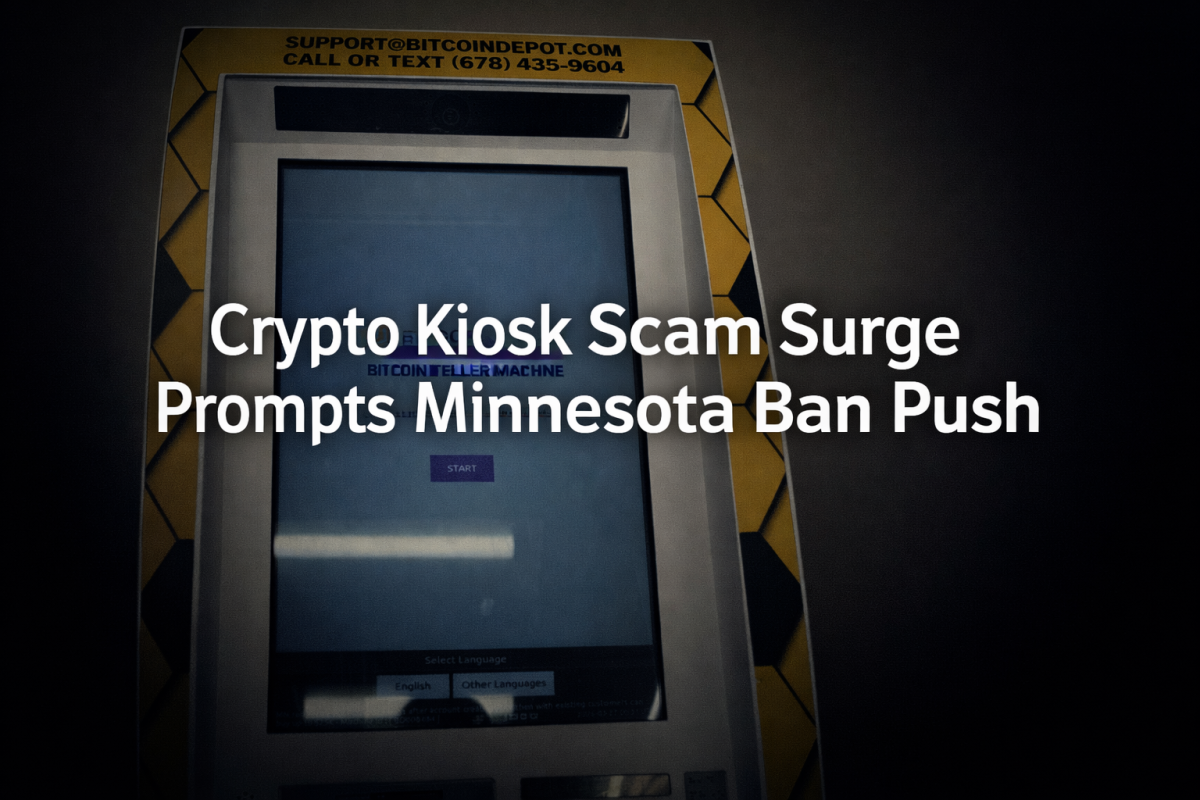
A crypto kiosk looks similar to a regular ATM machine. Users typically insert cash, and in some cases a debit card, to purchase cryptocurrency, which is then sent to a digital wallet. The funds typically move quickly into overseas exchanges that may not comply with U.S. laws.
In a letter to the Minnesota House Commerce Committee dated Feb. 20, Faribault Police Chief John Sherwin wrote that Faribault residents have reported losses of more than $500,000 due to kiosks since 2022; and that’s likely only 25% of all instances occurring in the city due to this underreported crime.
Chief Sherwin added that, “Based on our direct investigative experience, cryptocurrency ATMs have become a primary vehicle for financial exploitation, particularly of elderly residents.”
Police departments are urging families to talk to their older family members and alert them to these scams.
In an email to Woodbury News Net, Lawrence said, “As you have likely heard, cryptocurrency kiosks are just one of many tools scammers use to steal money from victims. Scam tactics evolve constantly, and we know that fraud — particularly involving cryptocurrency — is significantly underreported due to victims feeling embarrassed or afraid. Currently, there are at least a dozen crypto kiosks in Woodbury. They are most frequently located in gas stations, but can also be found in grocery stores, tobacco shops, and pharmacies.”
State Sen. Amanda Hemmingsen-Jaeger is the chief author of a bipartisan bill (SF 3868) prohibiting cryptocurrency kiosks in Minnesota. The bill was passed unanimously by the Senate Commerce and Consumer Protection Committee on March 12.
“Our law enforcement partners have seen a dramatic surge in scams targeting older Minnesotans through cryptocurrency kiosks,” Sen. Hemmingsen-Jaeger said. “Cryptocurrency scams resemble other scams that involve emotional manipulation, usually involving a loved one. Scammers cause victims to panic into irrational decision-making, defrauding victims of thousands of dollars.”
“A study by the Iowa Attorney General’s Office concluded that between 2023 to 2025, 98% of transactions at these kiosks were fraudulent. There are other ways for people to participate in the cryptocurrency markets through online sites and through apps. We don’t need to be going through these ATM type crypto machines,” Sen. Hemmingsen-Jaeger said.
A companion bill (HF 3642) in the House, authored by four Republican and three DFL representatives including the committee’s Chair Rep. Erin Koegel (DFL), is calling for a similar ban and is currently heading toward the House floor.
In addition to the ban, the bill calls for all virtual currency kiosks to be removed and any operator that conducts transactions only through a kiosk must pay out any virtual currency held for or owed to a customer by the end of the year.
Virtual currency kiosk operators oppose the ban, saying it’ll prevent them from operating in the state when they are not the ones conducting the scams.
Kiosk Operators
It is estimated that over 350 licensed crypto machines are installed statewide. They are operated by a handful of companies including CoinFlip, RockItCoin and Coinme.
Minnesota law effective Aug. 1, 2024, set a $2,000 daily limit for new customers (defined as those holding an account for less than 72 hours), required mandatory risk disclosures and compelled operators to issue refunds for fraudulent transactions to new customers within a 14-day window.
Sen. Hemmingsen-Jaeger also worked on that bill as a House member.
“We added definitions of new and existing customers to try to allow people who were taking part in the cryptocurrency market the ability to keep conducting their business, but also making sure that new customers would be refunded for fraudulent transactions,” Sen. Hemmingsen-Jaeger said.
There is reason to believe that the current law is providing some protection
According to the Woodbury Police Department, the documented losses are as follows:
- 2022: $108,300 in losses, with no refunds or recoveries
- 2023: $239,630 in losses, with approximately $11,519 refunded/recovered
- 2024: $193,510 in losses, with an estimated $65,045 refunded/recovered
- 2025: Approximately $32,130 in losses, with about $5,900 refunded/recovered
Two standing theories for the decrease are that the city’s increased education efforts are working and residents are being directed to kiosks in other cities, where intervention is less likely.
“It’s important to note that Wisconsin does not have the same requirements as Minnesota regarding mandatory refunds for first‑time victims or the limits established under Minnesota’s 2024 legislation,” Lawrence added. “We have had cases where Woodbury residents were instructed by scammers to cross into Wisconsin to complete their cryptocurrency transactions.”
Across the country, lawmakers are increasingly targeting crypto kiosks, with about 30 states introducing related legislation this year and 20 enacting laws as of 2026.
Many of the measures include consumer protections such as daily transaction limits and required fraud warnings, while also mandating state licensing for operators and transaction receipts to aid law enforcement investigations.
“Last month, Indiana, with strong support from AARP, became the first state to ban the machines from operating anywhere within its borders,” AARP said in a post on their website.
The bipartisan measure passed Indiana’s State Senate unanimously before being signed into law March 9.