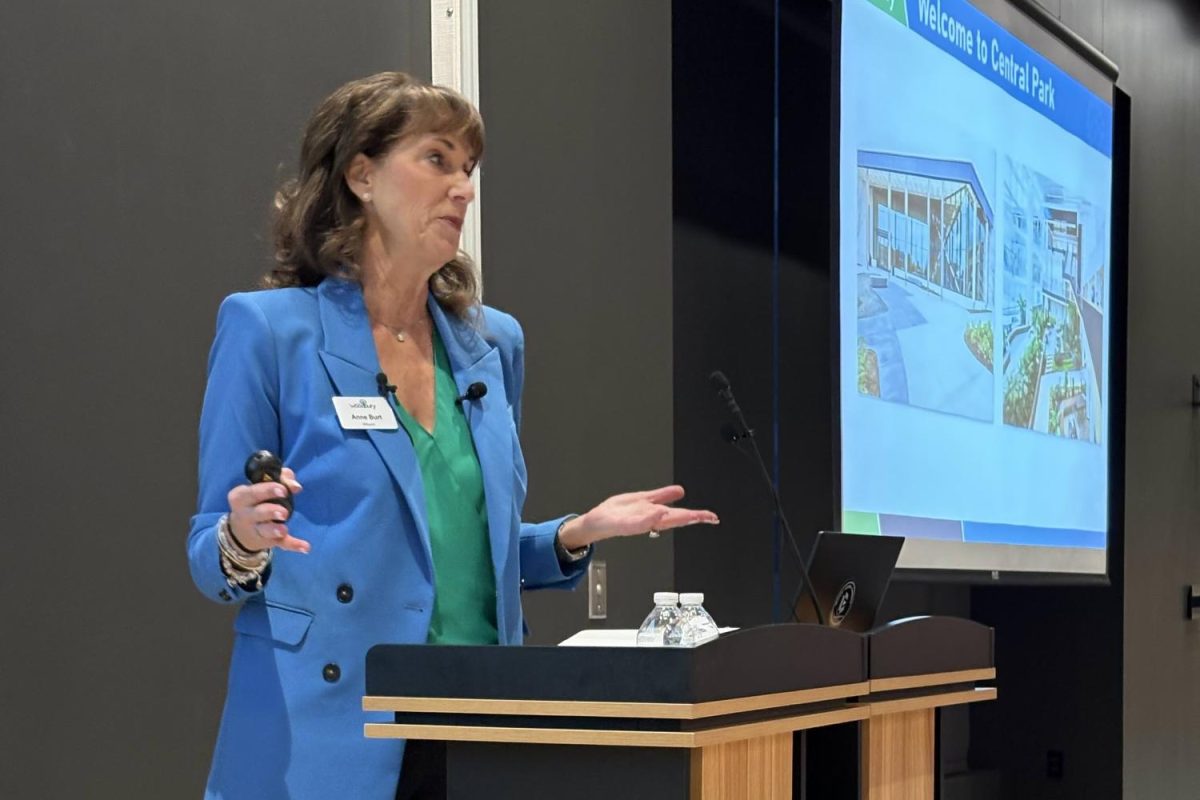

Minnesota Attorney General Keith Ellison hosted a community forum Thursday at the Central Park amphitheater where he spoke directly with residents about federal enforcement actions, constitutional authority, and fraud in state programs.
Ellison opened by explaining that his office has expanded its focus on federal accountability in response to recent national developments. He said that Minnesota has filed roughly 57 lawsuits against the Trump administration as part of that effort.
Minnesota State Sen. Amanda Hemmingsen-Jaeger (District 47), Reps. Ethan Cha (D-47B) and Shelley Buck (D-47A) were present at the forum along with Washington County Commissioner Karla Bigham and dozens more Woodbury residents.
Ellison told the audience that lawsuits are the primary legal tool available to his office when challenging federal actions. He then shifted to Operation Metro Surge, which he described as a central issue affecting Minnesota communities.
“There had never been a deployment of immigration agents of that size at one time and left in one place ever,” Ellison said. “This thing that happened here was historic in a bad way.”
Ellison said the number of federal immigration agents increased from roughly 80 to 100 covering a five-state region to an estimated 3,500 just in Minnesota. He mentioned the operation’s immeasurable impacts across Minnesota, including students not attending school, workers staying home, and businesses affected when workers did not report during the period of heightened enforcement.
The city of Minneapolis has estimated economic damages tied to the operation at about $203 million. according to Minneapolis officials.
Ellison also detailed one of Minnesota’s most recent lawsuits in constitutional limits on federal power.
“The federal government is a government of limited and enumerated powers, meaning that they can only do what they’re specifically designated to do,” he said. “When the federal government begins to intrude onto the prerogative of the state, now you’re talking about something called commandeering, which is a violation of the 10th amendment.”
That framework underpins the state’s argument that federal authorities cannot compel Minnesota to use its own personnel or systems to carry out immigration enforcement, even as state law still requires officials to inquire about nationality in certain felony cases and notify federal authorities when applicable. Those overlapping responsibilities (complying with state law while resisting federal overreach) form the basis of Minnesota’s ongoing lawsuit tied to Operation Metro Surge.
As the discussion shifted to what states can do moving forward, Ellison framed legislative action as both a legal test and demonstration of the public’s will power.
“I totally think that we should pass laws and we will find out whether or not they violate the Supremacy Clause,” Ellison said.
Measures such as requiring federal and local law enforcement officers to identify themselves or follow consistent standards could be pursued at the state level, with courts ultimately deciding whether those policies withstand constitutional scrutiny.
As the conversation moved to fraud and accountability, the Attorney General outlined both the scope of the present day issue of fraud in Minnesota and the structural limits of the authority of his office.
Ellison explained that the Attorney General’s Office has exclusive jurisdiction over Medicaid fraud, allowing it to independently prosecute those cases; but broader oversight of state agencies is divided among multiple entities, including counties, the legislative auditor and even the federal government.
Since taking office, Ellison said his team has prosecuted and convicted about 300 individuals in Medicaid fraud cases, recovering roughly $85 million in restitution and fines, though he noted gaps remain when cases fall outside that specific jurisdiction.
“There’s a lot of fraud that we cannot prosecute unless the county asks us to do it… And that’s why we need the U.S. Attorney’s Office as a partner,” he said.
Much of the recent fraud, he explained, has come from private vendors who entered state programs, billed for services and failed to deliver them, exposing weaknesses in how providers were screened and monitored.
“So the problem is more oversight for these vendors who were admitted to the program, promised to do good service by people, and didn’t do it,” he said.
Ellison said the state has strengthened multiple points in the system, including tighter screening before providers are approved, enhanced monitoring to flag unusual billing patterns and prepayment reviews designed to catch irregular claims before funds are distributed. Those efforts continue alongside prosecutions, with additional legislative changes under consideration, including a Medicaid Fraud Control bill that would expand the legal definition of fraud, making it easier to prosecute operators reentering programs and those who steal from Medicaid.
Despite the high-profile nature of recent cases, Ellison rejected the notion that Minnesota is an outlier.
“It is simply not true that Minnesota has more fraud than any other state,” he said.