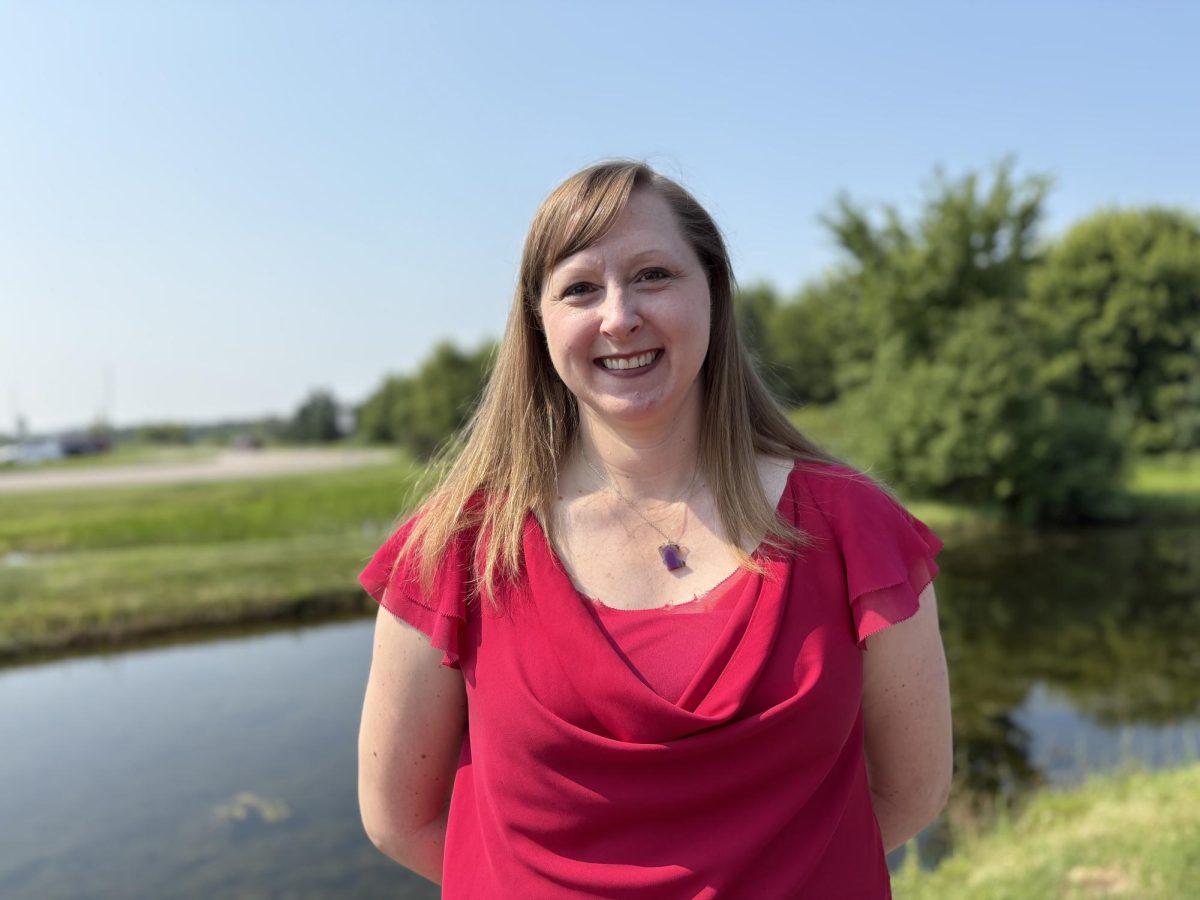
State Sen. Amanda Hemmingsen-Jaeger will enter the 2026 legislative session on Feb. 17 for her first full term in the Minnesota Senate, representing Senate District 47, which includes all of Woodbury and South Maplewood.
The DFL-member was first elected to the Minnesota House in 2022 and won a special election to the Senate following the resignation of former Sen. Nicole Mitchell last year.
With a short, non-budget session ahead and heightened political activity statewide, Hemmingsen-Jaeger spoke with Woodbury News Net about her transition to the Senate, her legislative priorities and the challenges she expects in the months ahead.
The following Q&A was edited for length and clarity.
Q: This will be your first full session in the Senate after serving in the House. What feels different about the job now, and what lessons from the House are shaping how you’re approaching this session?
Amanda Hemmingsen-Jaeger: I’m still excited. I feel like I get to still represent South Maplewood and Woodbury, but now it’s expanded to all of Woodbury. So that’s exciting. As for lessons from the house, I think really focusing on the issues has resulted in a really productive house tenure, able to get some bipartisan bills through the house, actually made some relationships with the Senate. So I feel like I’m starting with like a really good running start. I know have an idea of senators that I can have issues in common with, so we can work together on bills.
Q: Has that learning curve been too drastic, or has it been smoother since you had that experience in the House?
Amanda Hemmingsen-Jaeger: I think it’s a little smoother. Like, I understand how a bill goes from an idea to getting passed. I understand the culture of the parties, and I understand the committee structure and some of those logistical things. The other things that have just changed have just been your typical workplace stuff. Where’s the printer? Where’s the bathroom? Who do I talk to to get printing stuff? Who’s the new sergeant I should make sure I know? Some of just those normal workplace changes.
Q: On health care, and knowing your background [on the Health Finance and Policy Committee], what urgent fixes should we expect you to push this year, especially around prescription costs or provider access?
Amanda Hemmingsen-Jaeger: I’m still working on finalizing my specific bill priorities and those specific thoughts. I feel like this session is going to need to be focused on what’s coming at us from the federal level. I’ll be honest, with the cuts to SNAP and Medicaid and all of these other federal programs, our counties are hurting. Our people are hurting. There’s the threat of CMS withholding $2 billion a year in Medicaid costs and Medicaid monies. However, anything we can do to make things more affordable for Minnesotans, whether that’s decreasing prescription costs, making sure insurance companies are covering what they’re supposed to be covering, looking at ways to get Minnesotans the affordable access to health care that they need. I’m always, always, always going to be looking for those things.
Q: On your website, you mention a “Comprehensive ecosystem mindset” for environmental policy. What does that mean?
Amanda Hemmingsen-Jaeger: So many issues you can think about an issue of what is right in front of you, and you can try to solve that issue, but especially when we think about environment, health care, economy, addressing climate change, it’s not just what’s in front of you that’s impacted, but you need to be thinking about ancillary things that are impact. You need to be thinking about what’s going to happen down the road so especially with the environment. PFAs is a great example. We can try to address the immediate contamination, which is what we did with the settlement money. But what we’re finding out now is that that plume is much bigger than originally thought. It’s expanding to other communities. And we can help Woodbury with the drinking water and the treatment facility that’s being built, but what’s this going to do down the road if people have already been exposed? We saw what happened in Oakdale with those rare cancers hitting kids. How are we going to take care of those people in the area? Do we need to think about long term monitoring? Do we need to think about ways to take care of those people, or the type of environment? Do we need to worry about the soil health, which translates into our food? I think about all of those things that come together to get a comprehensive feel on what the issue is really about, and then the downstream consequences of those issues.
Q: Would that extend to recycling policy, transportation and heating?
Amanda Hemmingsen-Jaeger: Those are perfect examples of this complex ecosystem. So when we think about recycling, we think about critical minerals, so which we go into mining. So if we can get a really robust and supported recycling for E-waste, which there are bills on which I’ve supported in the past, and will continue to support. If we recycle, we decrease our demand on needing new precious metals, which then will help our boundary waters from getting mined. These are the things we can think about when we think about climate change. We’ve done a really good job addressing it in certain facets, but we know that these large scale industries, transportation and heating are now going to be the big thing that we need to tackle and how do we get greener energy from them.
Q: I set your issues up next to the League of Women Voters, and what they’re prioritizing for this session. And one of the gaps that I saw that you didn’t mention, but they had, was Election Administration and redistricting reform and ranked choice voting. So I just want to know a little bit more about what your stance is.
Amanda Hemmingsen-Jaeger: Those are all really great issues. I will just put out the disclaimer that I base my priorities on what I’ve heard from the community. It’s not to say that those issues are not important. They just haven’t risen to the top three. So when it comes to redistricting and election administration, Minnesota and Secretary of State Steve Simon have done a great job making sure our elections are secure and fair and well organized. Our county workers and our election workers have done a fantastic job making sure our elections run smoothly, securely and fairly and I think that’s represented by our high voter turnout. We are consistently number one and two in the country for voter turnout, which means that people have faith and confidence in our election system.
What we’re seeing right now is a response to what’s happening from these federal threats, and I think people want to make sure that their voices are heard through our democratic process, and we want to keep that intact. So when it comes to election administration, I’m going to make sure that the people of South Maplewood and Woodbury have their vote and they can feel confident casting their vote, and frankly, they can feel safe casting their vote. When it comes to redistricting, by luck, Minnesota has kind of had an impartial redistricting process. It happens every 10 years. When the census happens, they need to redraw the lines to be more representative of the people in the area. And because it just so happens that each year of those redistricting, we’ve had some sort of split governance where not one party has been in control of both chambers. So that has automatically gone to the courts to figure out.
I am in favor of keeping that impartiality. I don’t think elected officials should be able to pick their voters. It’s up to the voters to pick who represents them, so I’ve always been in favor of some sort of impartial mechanism to make sure that redistricting is done fairly equitably and representative.
Q: You saw the results with the ranked choice voting in Minneapolis and St. Paul. I’m curious if you still have the idea of expanding that ranked choice voting option greater than just the Twin Cities.
Amanda Hemmingsen-Jaeger: I supported a bill to give a local option for ranked choice voting. So should cities want to pursue that? They can have a better a better way to do that? I think it’s really interesting to do the ranked choice voting. We’ve been seeing some preliminary positive results or positive reactions to ranked choice voting in like St. Paul and Minneapolis. And for people that want to get away from the one-or-the-other choice, it allows a deeper conversation, because you’re going to be having more voices talking on. People can feel more confident that their votes are going to go for the people that they want, but they can also recognize that maybe there are other strong candidates, too. So I am still supportive of giving a local option to municipalities and to counties should they want to pursue ranked choice voting.
Q: Rep. [Leigh] Finke announced one of his proposals about transparency and accountability for federal law enforcement in Minnesota, and some of those include requiring officers to show their faces and marking their vehicles clearly. I want you to explain how you view state lawmakers in their responsibility of responding to those federal enforcement practices, and would you support similar measures?
Amanda Hemmingsen-Jaeger: If we’re going to have unmasked unidentifiable people coming and behaving in these violent and unlawful ways and interacting with our communities, it’s our responsibility to make sure communities are protected. If we have expectations of our own local law enforcement and our county law enforcement to be identifiable, to wear and have on their body cams, to behave in a manner that prioritizes deescalation and honors constitutional rights, then we should have that expectation of anybody coming into our communities.
I’ve actually had a conversation with the Woodbury Police Department and I fully support their ideas of not allowing officers and agents to be masked and making sure that they clearly identify the agency that they’re working for… We should know who’s in our community, either pretending to enforce laws or whatever direction they’ve been given to interact with our citizens. And if that means that we need to create some state laws to make that consistent across the state, then I fully support it.
Q: You were present at the Jan. 14 city council meeting in Woodbury. What were your impressions on that?
Amanda Hemmingsen-Jaeger: I was really proud of our community. I was very impressed at how quickly the community was able to mobilize. The fact that city hall was overfilled and yet presented in such a way that was peaceful, that was describing lived experiences, and was asking our city officials to stand with the community and to make a statement and to be there for community, I think was really inspiring. And it continues to show that Woodbury is a caring community. We’re compassionate. We care about our neighbors. You can see that with the regular sign waving at corners. We see it with the neighborhood patrols. We see it with mutual aid. And I think we’re really a leader in the East Metro and we’re showing that with these types of community actions.
Q: If there’s one thing you want to accomplish this session, what is it?
Amanda Hemmingsen-Jaeger: My first priority is to make sure that we are protecting Minnesotans. We are protecting what they need, and we are doing whatever we can to make life more affordable for Minnesotans.