The Woodbury City Council approved a new property tax levy on Wednesday, setting a 9.7% increase for 2026 that city leaders say reflects rising costs and an investment in public safety.
City Administrator Jeffrey Dahl said the city initially faced a steeper increase before staff adjusted revenues, cut planned expenses and eliminated a proposed debt levy.
“This year’s theme is really about not only being a premier community, which is our overall mission, but really a commitment to public safety,” Dahl told council members during the budget presentation.
Last year, the adopted 2025 total property tax levy (including the HRA property tax levy) was 8.3% above 2024, topping the city’s 15-year historic average increase of 4.4%.
A significant portion of the increase is tied to staffing. The city plans to add 16 full-time positions in 2026, including 13 in public safety across police, fire and emergency medical services. The funds are essential to providing a full staff in Woodbury’s Public Safety Department, a milestone Dahl described as difficult but necessary.
“Having the best public safety officials means we have to compensate them appropriately,” he said.
The city’s total operating budget for 2026 is nearly $154 million, though after accounting for transfers and offsetting expenditures, the net budget funded by levy and non-levy revenues comes to $132.1 million.
Non-levy revenues, including permits, administrative fees and grants, continue to play a growing role; Dahl said staff secured $1.7 million in operational and capital grants in 2025, in addition to roughly $80 million in water-quality related funding tied to major infrastructure projects.
Those projects include a $300 million-plus water treatment plant and pipeline effort, a new public safety building estimated at $60 million, as well as the annual roadway and trail resurfacing work.
What is a property tax levy?
A property tax levy is the total amount of money a city collects from property owners to fund municipal services. Individual tax bills are calculated by dividing the levy across the city’s total taxable property value, meaning changes in property values directly affect how much each homeowner pays.
A jurisdiction’s levy is only one part of a property tax bill. School districts, Washington County and other taxing authorities also set levies, and shifts in market values can change how the overall burden is distributed among homeowners, apartments and commercial properties.
In Woodbury, the city portion accounts for about 26% of a typical property tax bill, with the remainder largely driven by county and school district levies.
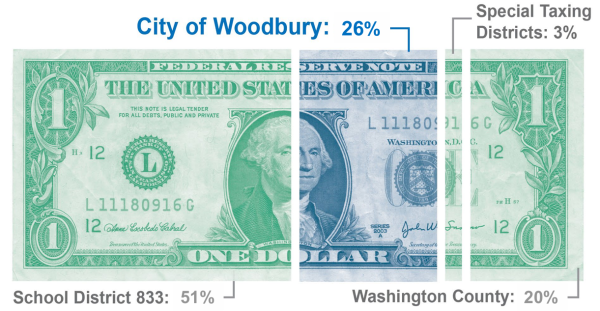
For a median-value Woodbury home, now estimated at $451,000 — up from $441,000 last year — the city tax portion will rise to about $1,475 in 2026. That represents an increase of roughly $115, or about 8.5%, slightly below the full levy increase due to growth in the city’s tax base outside of homeowners.
Where does the money go?
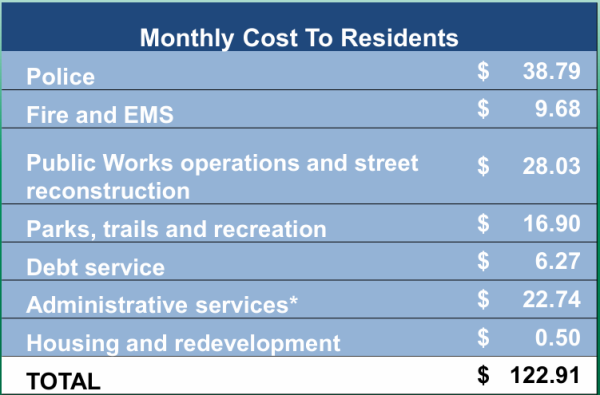
More than 75% of the city tax bill funds essential services, including police, fire, public works, parks and trails. On a monthly basis, that equals just under $123 per household, according to city estimates.
“All the snow plows and the plowing that happened over the past few days, and our great public safety teams addressing accidents, that’s where the lion’s share of the money is going,” Dahl said.
Inflation and state mandates also played a role in the levy increase; one major driver is Minnesota’s new paid family and medical leave program, which Dahl described as an unfunded mandate that creates both direct costs and staffing challenges.
“The state passed legislation to allow that, and they’re not funding the entire or even more than half of the benefit,” he said.
How does Woodbury compare to others?
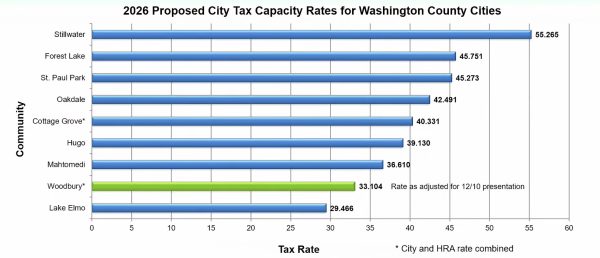
Despite the increase, Woodbury’s overall tax rate remains among the lowest in the region when compared with similar-sized cities. Even with the 9.7% levy increase, Woodbury ranks near the bottom among comparable Washington County communities.
“That was a surprise for me,” Dahl said, noting that the city’s tax rate had steadily declined for more than a decade before recent inflation-driven pressures reversed the trend.
The average levy increase over the past 15 years is 4.9%, making the 2026 increase the highest in that span. Dahl said staff hope longer-term planning and stabilizing costs will prevent similar spikes in future years.
City officials emphasized that while the levy increase is significant, it reflects the cost of maintaining services in a growing city, and that residents’ total tax bills depend on decisions made well beyond City Hall.
County levy also approved
Washington County commissioners approved the county’s 2026 property tax levy and budget on Tuesday, setting the certified levy at roughly $150.1 million. The board also approved a $660,000 levy for the Regional Rail Authority and $1.2 million for the Land and Water Legacy Program, both unchanged from prior years, along with a $7 million levy for the Washington County Community Development Agency.
The county levy represents a 6.95% increase over 2025, the lowest proposed county levy increase in the metro area. Washington County also had the third-lowest levy per capita statewide in 2025 and is projected to have the second-lowest tax rate in the seven-county metro in 2026.
For a median-valued home, the county portion of property taxes is estimated to rise between $31 and $58, depending on value. The 2026 budget funds capital projects (Central Yard Waste Site, Park Grove Library, road construction, and parks improvements) and mandated programs, with remaining revenues coming from state and federal sources, grants and service fees.
Beth-Ann Bloom, reporter, contributed to this story.